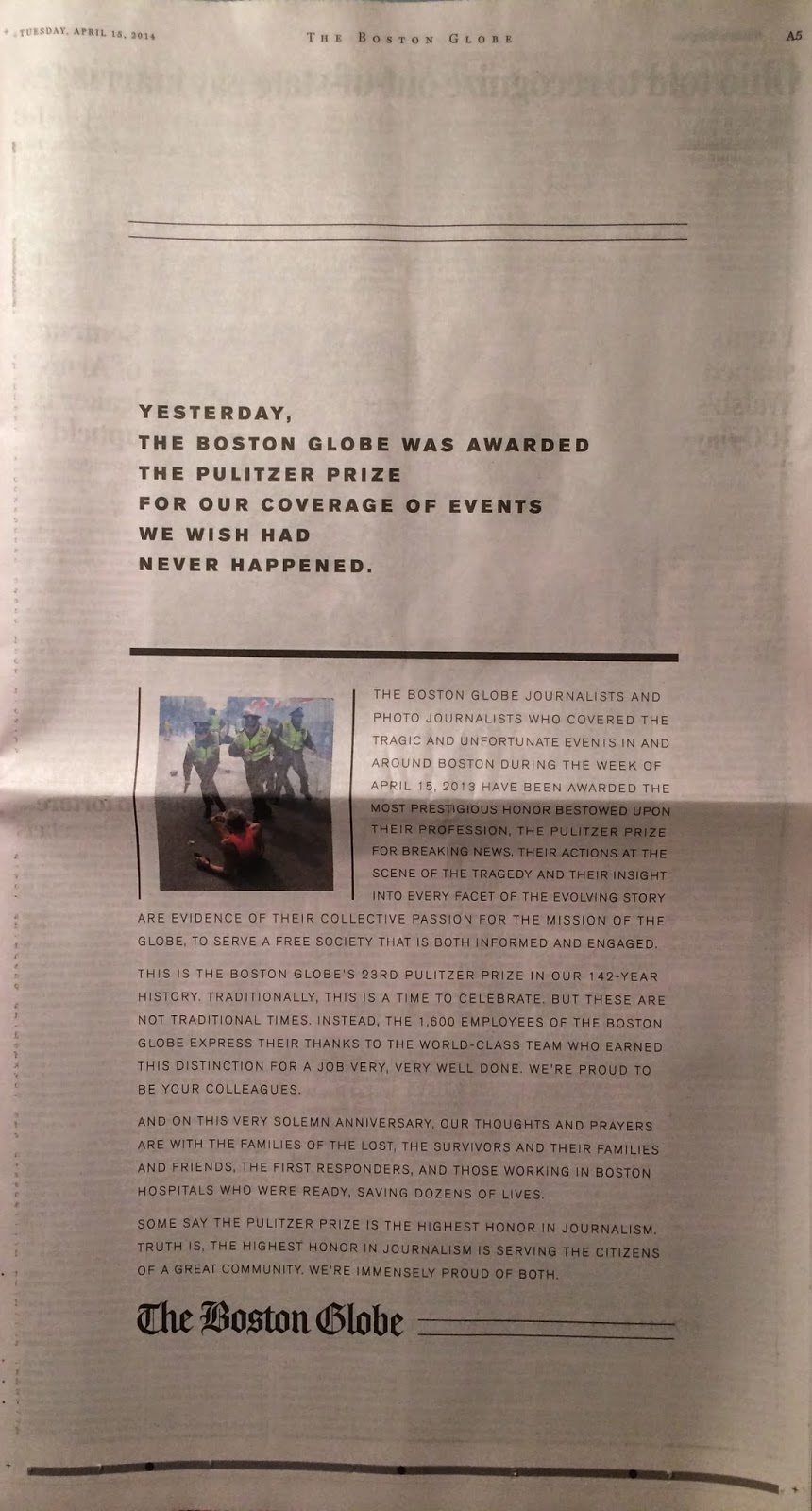
This day in the middle of April marks a lot of anniversaries, and most of them are pretty sad. Let's begin with the local news: the first anniversary of the bombings during the CXVII Boston Marathon.
Tuesday, April 15, 2014
Monday, April 14, 2014
Philosophy of Time
We do not have any time. This short, but very wise and full of significance sentence I always knew for sure but today I understood it as clear as probably never before. If you are of those kind of people who accidentally write the previous month or year when signing the date, accept my congratulations. And if you don't see a problem in it, I suggest to re-revise it completely. Sometimes it can look like there is so much time ahead, but the first impression is always deceptively. Let me tell why.
Most of the people, when they are young, feel like the time is so sluggish and you are likely to wait an eternity or two until you become big and grown-up. Accept it: who don't remember those preschool years, when you were lying on the bed at your kindergarten during the day sleeping hour, watching in the window and looking forward to the end of the day. Used to be, didn't it? What would you say now?
I first noticed then when my Grandmother bought a huge wall clock. It was really big, and once really bored during the summer vacation, I watched its minute hand. The mechanism of the clock was quartz, it had no hand which showed seconds, however the mechanism was working as standard: every second the motor made a full movement which setted gears in motion, which in their turn moved the minute hand. Because of that construction, the minute hand did a very tiny movement every second, dividing each minute on sixty time pieces. And since the face of the clock was so huge, I could easily see each movement. That was the moment in my life when I realized how quickly the hand will return on its place and how one hour is actually short. It was shocking and scary. I watched the hand for only five or ten minutes, but that was more than enough to realize how quickly did they flew by. Some time before, at the age of eight, I accidentally watched one interesting music video on the television. The song was called "Time" by Irakly Pyrzhalava. I remembered the moment when the dude was trying to stop the time for a moment by holding a hand of a big tower clock which actually fell from that tower a moment before. He succeed for a moment, but had to give up since the hand was like an edge or a very sharp knife, which seriously cut guy's handbreadth when he was holding it. When looking at Grandma's clock, I associated myself with that guy.
So what's the point? The point is that with years the situation is getting worse.
Monday, April 7, 2014
Philosophy and Arnold Arboretum neighborhood review
Hello my dear readers, and those who suffer insomnia, just like me now, and will read this post first, please receive my special greetings. Here is the main point: I publish a new post at the very end of the day, when it is around ten or eleven o'clock in the evening on the East Coast, so the date which you see above the heading is not the day when the post is fresh (like a newspaper), but the date when it was published, more certain, its very end. If you are reading me not from both of Americas, the moment when I publish my post is your very late night, and it is already your "tomorrow", not my "today". So if you try to read my posts as early as you can but always see yesterday's date, please, don't be disappointed. It is the way that it should be. To illustrate, I wrote a week ago that the new posts will be uploaded every Monday with some additional ones during the week. At this point you should expect a new post not on Monday, but on early Tuesday morning, it would be better to say, on early Tuesday night. If you are, however, in one of the Americas, it is uploaded very late on Monday.
Another fact, which is also important to point on, is that I recently found out that sometimes (it doesn't happen very often but rarely such a situation occurs) the certain post is not fully uploaded at the moment of publication, and it completes the uploading some time after, especially when there are a lot of photographs. I have no idea why this happens, I will talk to my Internet provider on that, but it goes as it goes. At this point, today's post will be experimental.
This week is the first week of the last quarter of my first course. Not to confuse you, I will explain that I am a university freshman and at the end of June my first course (first academic year) will be over.
Today I had my first Philosophy lecture. By the term "first" I mean first in my life, ever. If I had to describe it in one word, the word would be "Super-Duper!". The lecture, and the topics we discussed, were really stunningly, with no exaggerations. The full name of the course is "Introduction to Philosophy and Ethics", so today's lecture was, at some point of view, an introduction to an introduction. I will be very glad to tell you what were we talking about today. Glimpsing at my conspectus and recalling my short-term memory, here are the things which come from the top of my head at the first point:
To introduce the topic, it would be pertinent to raise the question: "What is Philosophy?" This question is difficult to answer and can't be answered with a certain statement or definition. Philosophy begins with wonder, with coming up with questions like "Why there is something except nothing?" Philosophy at modern times has an uncountable amount of branches, but traditionally it is divided into four ones, which are Metaphysics, Ethics, Epistemology and Logic. Let me tell you in more detail what each of these branches stand for.
Metaphysics is a branch of philosophy that is concerned with the ultimate question of reality. It tries to answer questions such as "Why do things really exist?", or "Do they actually exist at all?" "Is everything which surround us has only a physical origin, or do non-physical things take their place in our life too? What about spirituality, soul?" "Does everything that happens have a cause? Are our actions free, or are we fated to do what we do?" "Does life have a meaning or purpose?". These questions are inextricably connected with such a thing as ontology. Ontology, in its turn, is a list of things that exist, take place in our life. The main thing with ontology, and with the answers to all of the questions I listed above, is that they are all personal and different for everyone, depending on a person who comes up with an answer or knows it for sure. It mainly depends on religion (atheism and agnosticism are religions too), but a lot of other factors from life make their impact on one's point of view as well.
Does donut holes exist? When professor asked this question to the auditorium, I, and all my group mates, were shocked (it is not the word). I simply can't find words to describe my feelings after asking myself this question. Donut hall has a shadow, that's doubtless. You can put things threw it, that's another fact. But when you eat a donut, where does the hole go? This leads us to the original question, "Do they actually exist at all?". As I wrote before, this kind of questions can drive one mad, and that is the reason why I never asked them myself. For fatalism (which is believing in destiny as a life scenery written in advance, beforehand) there are also some interesting arguments, which are both agreements and disagreements. To illustrate, I can pick up a pen from the table and I can leave it alone. What will I do? That is a brief summary for metaphysics.
Ethics is another original branch of philosophy which is also called "the theory of morality". Questions of abortion, euthanasia, cloning, &tc., are the questions of the field of ethics. What makes an action morally right or morally wrong? Are there objective standards of rightness and wrongness? Can the things which are right for one person be wrong for another? When, if ever, does the term "end of justify" mean and take place? Does the sphere of morality extend to all animals except humans, or can we treat them any way we want? What is the connection between law and morality? And, to sum up, how should we live? All those questions, which ethics ask, also have one thing in common: a free answer, not "yes" or "no", "exist" or "do not exist". At some point, they are also personal.
Here another interesting fact popped up: as I have already wrote above, the course is known under the name "Introduction to Philosophy and Ethics". If Ethich is one of four traditional branches of philosophy, does it mean that the course will make a big accent on it? I'll see.
Epistemology, or the theory of knowledge, is a branch of philosophy that investigates the nature and scope of knowledge. It is connected with questions such as "What is knowledge? How does it differ from mere belief? Is perception a genuine source of knowledge?"
Logic, which is the last category, deals with questions such as "What good reasoning is? What is the difference between correct and incorrect reasoning? What makes an argument valid or invalid, what makes it cogent or uncogent? (later I will tell you in more detail about this particularly)".
Please relax, I will stop right now. Now I would like to entertain you with some photos, so your brain will not explode and your loved ones will not have to wash ceiling, walls and floor of it, whispering vulgar words about you.
After the Philosophy lecture I, shocked by the received material, wend my way home home past Arnold Arboretum. After I left the auditorium, I walked past some buildings which make an inner yard of my alma mater. I still wonder if those buildings are, what is called, on-campus housing apartments. I made this photo just because I liked the lamps in the ground, lighting the tree in this way. The buildings I wrote about can be seen behind.
I have never been to Arnold Arboretum neighborhood before, and so it happened that my first time, today, was during the darkness.
I like the contrast of the lights, dark sky and ground.
And here is where locals live. A very "green" neighborhood, by the way. A lot of grass, and trees.
Another fact, which is also important to point on, is that I recently found out that sometimes (it doesn't happen very often but rarely such a situation occurs) the certain post is not fully uploaded at the moment of publication, and it completes the uploading some time after, especially when there are a lot of photographs. I have no idea why this happens, I will talk to my Internet provider on that, but it goes as it goes. At this point, today's post will be experimental.
This week is the first week of the last quarter of my first course. Not to confuse you, I will explain that I am a university freshman and at the end of June my first course (first academic year) will be over.
Today I had my first Philosophy lecture. By the term "first" I mean first in my life, ever. If I had to describe it in one word, the word would be "Super-Duper!". The lecture, and the topics we discussed, were really stunningly, with no exaggerations. The full name of the course is "Introduction to Philosophy and Ethics", so today's lecture was, at some point of view, an introduction to an introduction. I will be very glad to tell you what were we talking about today. Glimpsing at my conspectus and recalling my short-term memory, here are the things which come from the top of my head at the first point:
To introduce the topic, it would be pertinent to raise the question: "What is Philosophy?" This question is difficult to answer and can't be answered with a certain statement or definition. Philosophy begins with wonder, with coming up with questions like "Why there is something except nothing?" Philosophy at modern times has an uncountable amount of branches, but traditionally it is divided into four ones, which are Metaphysics, Ethics, Epistemology and Logic. Let me tell you in more detail what each of these branches stand for.
Metaphysics is a branch of philosophy that is concerned with the ultimate question of reality. It tries to answer questions such as "Why do things really exist?", or "Do they actually exist at all?" "Is everything which surround us has only a physical origin, or do non-physical things take their place in our life too? What about spirituality, soul?" "Does everything that happens have a cause? Are our actions free, or are we fated to do what we do?" "Does life have a meaning or purpose?". These questions are inextricably connected with such a thing as ontology. Ontology, in its turn, is a list of things that exist, take place in our life. The main thing with ontology, and with the answers to all of the questions I listed above, is that they are all personal and different for everyone, depending on a person who comes up with an answer or knows it for sure. It mainly depends on religion (atheism and agnosticism are religions too), but a lot of other factors from life make their impact on one's point of view as well.
Does donut holes exist? When professor asked this question to the auditorium, I, and all my group mates, were shocked (it is not the word). I simply can't find words to describe my feelings after asking myself this question. Donut hall has a shadow, that's doubtless. You can put things threw it, that's another fact. But when you eat a donut, where does the hole go? This leads us to the original question, "Do they actually exist at all?". As I wrote before, this kind of questions can drive one mad, and that is the reason why I never asked them myself. For fatalism (which is believing in destiny as a life scenery written in advance, beforehand) there are also some interesting arguments, which are both agreements and disagreements. To illustrate, I can pick up a pen from the table and I can leave it alone. What will I do? That is a brief summary for metaphysics.
Ethics is another original branch of philosophy which is also called "the theory of morality". Questions of abortion, euthanasia, cloning, &tc., are the questions of the field of ethics. What makes an action morally right or morally wrong? Are there objective standards of rightness and wrongness? Can the things which are right for one person be wrong for another? When, if ever, does the term "end of justify" mean and take place? Does the sphere of morality extend to all animals except humans, or can we treat them any way we want? What is the connection between law and morality? And, to sum up, how should we live? All those questions, which ethics ask, also have one thing in common: a free answer, not "yes" or "no", "exist" or "do not exist". At some point, they are also personal.
Here another interesting fact popped up: as I have already wrote above, the course is known under the name "Introduction to Philosophy and Ethics". If Ethich is one of four traditional branches of philosophy, does it mean that the course will make a big accent on it? I'll see.
Epistemology, or the theory of knowledge, is a branch of philosophy that investigates the nature and scope of knowledge. It is connected with questions such as "What is knowledge? How does it differ from mere belief? Is perception a genuine source of knowledge?"
Logic, which is the last category, deals with questions such as "What good reasoning is? What is the difference between correct and incorrect reasoning? What makes an argument valid or invalid, what makes it cogent or uncogent? (later I will tell you in more detail about this particularly)".
Please relax, I will stop right now. Now I would like to entertain you with some photos, so your brain will not explode and your loved ones will not have to wash ceiling, walls and floor of it, whispering vulgar words about you.
After the Philosophy lecture I, shocked by the received material, wend my way home home past Arnold Arboretum. After I left the auditorium, I walked past some buildings which make an inner yard of my alma mater. I still wonder if those buildings are, what is called, on-campus housing apartments. I made this photo just because I liked the lamps in the ground, lighting the tree in this way. The buildings I wrote about can be seen behind.
I have never been to Arnold Arboretum neighborhood before, and so it happened that my first time, today, was during the darkness.
I like the contrast of the lights, dark sky and ground.
Tennis court.
The loan is illuminated so strongly by the projectors in the wall, that it feels like a daytime.And here is where locals live. A very "green" neighborhood, by the way. A lot of grass, and trees.
This is not far from the place where I live, an empty parking lot (no wonder that it's empty, who drives to hospital at night?) with a breathtaking sight of Boston skyline from the south. Northern one is much more popular, but what I (and now you as well) can see from here is also great. I live in a very mountainous place, and it is pretty tiring to walk up the hill in the direction of my home and down the hill, back to the city or somewhere else. Such a landscape is probably the only benefit from which I actually benefit.
The photos in contrast with the main topic are nice, but let me, nevertheless, continue with Philosophy.
What is more strange, as I noticed, the lecture was held with the main accent on the last division of philosophy, which is logic but not ethics, the second one, as the name of the course announces. This made me feel really confused but not not less enthusiastic. All the rest of the lecture, as far, was about logic. Here is what professor Oro (yes, that is his real last name) generally talked about:
Philosophers offer reasons and arguments which support things they state. Logic at this point plays a special role in philosophy.
There are even more sub-branches of philosophy as well: for any discipline that you can name, there is also the philosophy of that discipline. For example, not only we have discipline of mathematics, science and religion, but we also have philosophy of science, philosophy of mathematics and philosophy of religion (oh yeah, religion has its own philosophy!). When Albert Einstein came up with his theories, nobody understood them. Later, what is more, nobody believed they are right.
What are the reasons for studying Philosophy? The reasons are, firstly, that philosophy deals with questions which are, so far, unanswered, or at least there is no real consensus which can potentially lead to the correct answer. This makes it an interesting subject.
<
< {insert [arguments_and_validity}>
<
To sum up, I would say that I have already came up with those ideas some time before, at the time of my active brain and mind development, as I think all my group mates did so far, but I never took those questions seriously, never thought they can be seen as an individual science, never spent time thinking on them (well, maybe a couple times spending my pleasure minutes on the toilet seat (don't criticize me for that, you know what it is!)).
That will be all for today. Please comment, I highly appreciate any criticism. Stay safe!
Friday, April 4, 2014
Mourning post
Since March twenty-seventh, and until the end of this week, Boston is dressed in black crape, mourning the two fallen firefighters, Edward Walsh and Michael Kennedy, who both gave their lives for the service at three o'clock alarm fire on March 26th. Because the mourning is very massive and is taken very seriously, I am publishing this sad post in honor of the fallen heroes.
file://localhost/Users/Diego/Downloads/ac139899-ea99-4bc4-8c65-ca08afabea84.pdf
Subscribe to:
Posts (Atom)